Many organizations are now using AI agents. The challenge is no longer just how to apply AI tools or validate AI testing scenarios. AI solutions have moved beyond simple querying and exploration. The real issue is enterprise-wide adoption and absorption of AI. As AI solutions scale across the enterprise, they require a clear architectural model to guide direction, redesign, and long-term sustainability.
Enterprise architecture (EA) is increasingly becoming a context curator, heavily assisted by AI, while solution design (SD), with its more confined scope, is largely being automated by AI. However, enterprise solution architecture (ESA) or large-scale solution architecture (SA), which bridges EA and SD, operates within unique environmental and organizational constraints that still require significant human involvement, whether through human-centric oversight, delegation, or collaboration. Without this level of architectural guidance and assurance, AI may operate in ways that fail to align with business intent or produce systems that become uncertain or overly complex, difficult to adapt, and hard to maintain.
AI Solution Architecture (ASA), also referred to as AI-ESA, is based on the enterprise solution architecture (ESA) modeling approach (also referred to as Agile ESA, abbreviated as AESA or A-ESA) to support enterprise-grade AI solution architecture.
For the detailed ASA model specification and approaches, see the link.
You can also try the minimalist online ASA modeling tool at ai.a-esa.com.
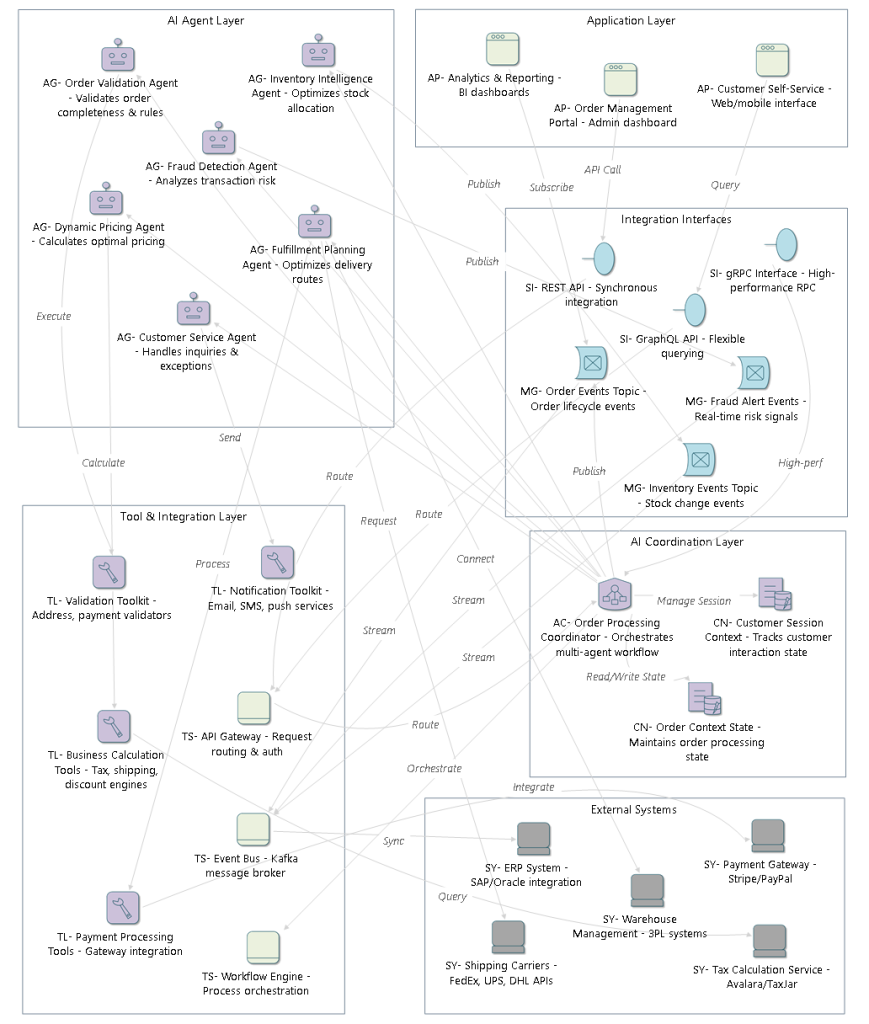
The following illustrates an anti-pattern view of AI solution architecture.